
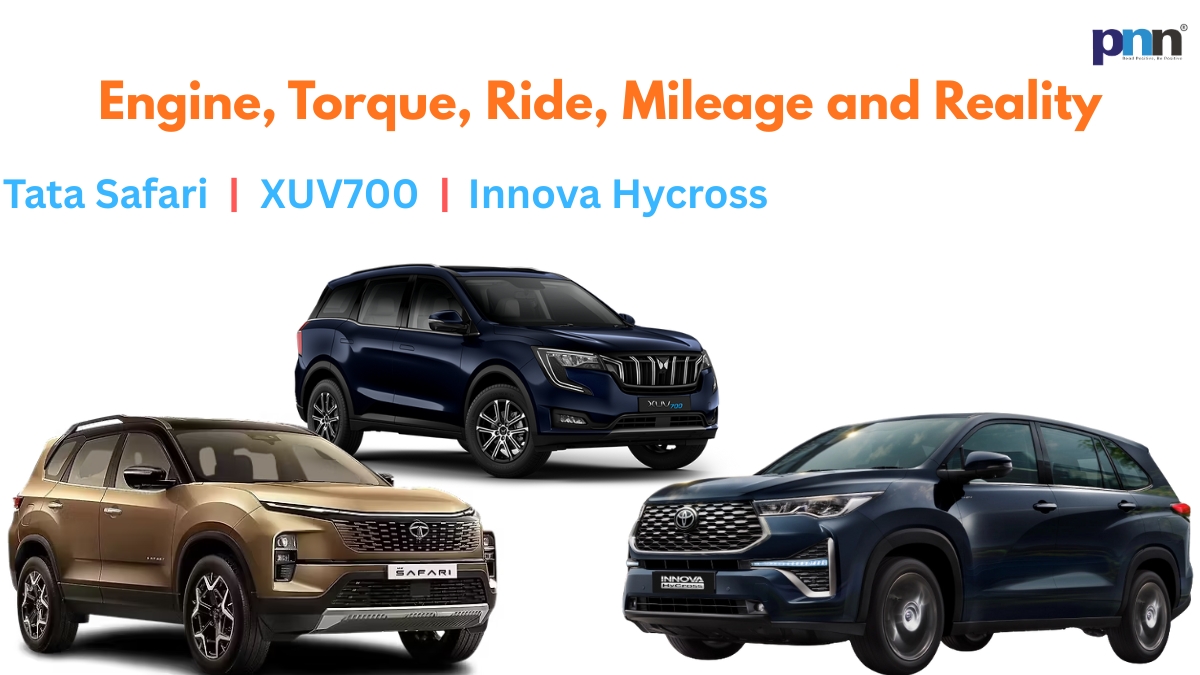
You look at the price first because there’s no polite way around it. The Safari and XUV700 play in the same invoice band. The Hycross quietly climbs higher once you spec it the way people actually do. On paper, they overlap. In reality, they’re solving different problems while pretending to be rivals.
The Safari charges you for presence, a diesel that still matters, and a ladder-frame hangover it hasn’t fully shaken. The XUV700 charges you for tech density and outright performance, then asks you to trust Mahindra to keep the software behaving. The Hycross asks for more money and gives you fewer emotional cues, but it also removes friction from ownership in ways most people only understand after three years. This isn’t aspiration. It’s domestic logistics.
Engine & Performance
Tata Safari
What you get: a familiar 2.0 diesel that pulls cleanly from low revs and never surprises you.
Price factor: you’re paying for torque delivery you already understand and can rely on.
Con: it feels dated next to the XUV700. Power tapers early.
What you get: the strongest engines here. Diesel pulls hard, petrol pulls harder.
Price factor: more power, more electronics, more complexity baked into the cost.
Con: performance comes with heat, software dependency, and the occasional gremlin.
Toyota Innova Hycross
What you get: hybrid smoothness, instant low-speed response, zero drama.
Price factor: you’re paying for efficiency and mechanical restraint, not thrills.
Con: no diesel punch. High-speed urgency feels muted.
Transmission
Safari
You get a torque converter that behaves itself. No surprises.
On-road price value: predictability in traffic and on highways.
Con: slow reactions when pushed.
XUV700
You get quicker responses. Feels more modern.
Lower price-to-performance ratio buys speed, not polish.
Con: shifts can feel abrupt when driven casually.
Hycross
You get an e-CVT that fades into the background.
Price buys absence of effort.
Con: enthusiasts will hate how disconnected it feels.
Chassis & Stability
Safari
You get weight. It feels planted on highways.
Price pays for size and stance.
Con: body movement is always present.
XUV700
You get agility that feels wrong for its size — in a good way.
Lower price compared to performance compromises ultimate composure on broken roads.
Con: feels nervous when fully loaded.
Hycross
You get calm. Always.
Price buys balance and low centre of gravity.
Con: no sense of occasion.
Suspension
Safari
Compliant, absorbs bad surfaces.
Price buys long-distance ease.
Con: floaty at speed.
XUV700
Firmer, more controlled.
Price factor: sportier tuning.
Con: sharp edges make it through.
Hycross
Soft, quiet, forgiving.
Price buys fatigue-free days.
Con: zero feedback.
Braking
Safari
Progressive, easy to trust.
Price investment buys confidence.
Con: lacks bite.
XUV700
Stronger bite.
Price pays for performance.
Con: can feel grabby.
Hycross
Seamless regen + brake blend.
Price buys consistency.
Con: feels artificial.
Ergonomics & Comfort
Safari
Commanding seats, space.
Price is partly for posture.
Con: third row tolerable, not generous.
XUV700
Tech first cabin, good front seats.
Price buys screens and features.
Con: third row feels like an afterthought.
Hycross
Actual room everywhere.
Price buys family-first packaging.
Con: interior lacks character.
Fuel Efficiency & Ownership
Safari
Diesel economy is serviceable.
Price includes Tata’s improving but uneven service network.
Con: resale uncertainty.
XUV700
Efficiency varies wildly with driving style.
Price doesn’t insulate you from software gremlins.
Con: ownership anxiety exists.
Hycross
Best mileage here. Hybrid logic works.
Price includes Toyota’s tedious reliability.
Con: initial cost stings.
This isn’t a comparison of “best SUVs.” That argument ended years ago. The Safari sells familiarity. The XUV700 sells intensity. The Hycross sells silence and time you don’t spend at service centres. You pick based on what you’re willing to live with every day. Everything else is noise.
Price and Key Details Table
| Specification | Tata Safari | Mahindra XUV700 | Toyota Innova Hycross |
| Typical On-Road Price (India) | ₹18–26 lakh | ₹17–27 lakh | ₹26–33 lakh |
| Engine Type | 2.0 L Diesel / Petrol | 2.0 L Turbo Petrol / Diesel | 2.0 L Petrol Hybrid |
| Max Power | ~170 hp | ~200 hp (petrol) | ~185 hp (combined) |
| Max Torque | ~380 Nm | 380–450+ Nm | Hybrid-assisted |
| Gearbox | 6-speed AT/MT | 6-speed AT/MT | e-CVT |
| Real-World Mileage | 12–16 km/l | 11–17 km/l | 18–22 km/l |
| Seating | 7 | 7 | 7 |
No moral. No unresolved tension.
The vehicles made their choices years ago.
People just keep arguing because they like pretending it’s close.


