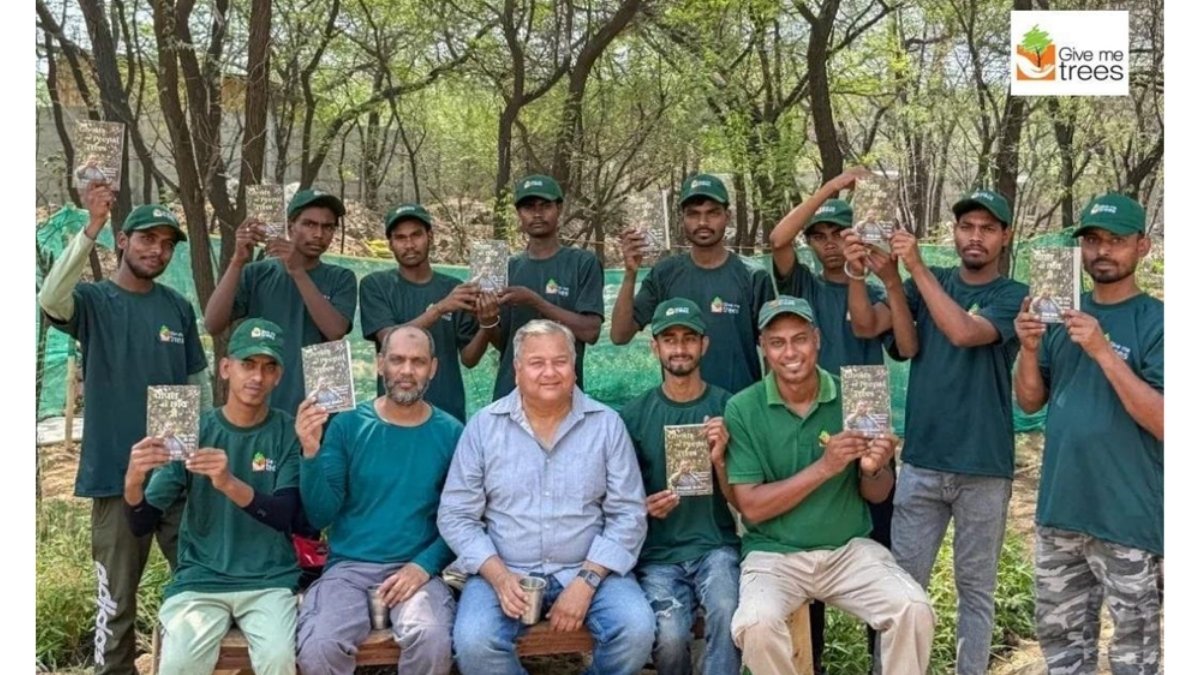
New Delhi [India], June 11: This Environment Fortnight is significant in many ways, with events taking place across the country. To mark the occasion, the highly anticipated book Ghosts on Peepal Trees—based on the environmental conservation work of renowned activist Peepal Baba—was launched in Gurugram. The launch took place on the eve of World Environment Day during a tree-planting ceremony where Peepal Baba planted saplings alongside employees from Penguin Publications. Subsequently, on World Environment Day itself, he formally unveiled the book at the Baba Neem Karoli Ashram in Chhatarpur, Delhi, by planting trees amidst the ‘Ashram of Trees’ alongside his volunteers. Since then, the book has been undergoing daily launches at various plantation sites across the country. A target has been set to launch the book at 15 locations over 15 days; so far, 10,700 copies have been purchased. Furthermore, this book is scheduled to be launched during this Environment Fortnight amidst the forests being created by Peepal Baba at locations such as Sorkha (Noida-115), Maincha (Greater Noida), Rahimabad (Lucknow), Khatauli, Meerut Cantt, Barmer, Pune, Karma Lakeland, and others.
The book weaves together themes of the environment, spirituality, and human emotion. It is not merely a story about trees but an exploration of the profound bond between humanity and nature that has existed for centuries. Through his life experiences, memories, and reflections, Peepal Baba demonstrates that the Peepal tree is not just a natural entity but a symbol of energy, consciousness, and spirituality. The author presents the special significance of this tree in Indian culture from a modern perspective. The book not only raises awareness about environmental conservation among readers but also inspires them to experience a deep connection—both within themselves and with the natural world.
Faith is the seed of every movement. It begins with a quiet voice—a desire to do something good—and eventually grows into a forest as others come to share that same sentiment. Peepal Baba reveals that the idea for this book first came to him in 2012. It took over a decade to find the time and peace of mind to bring this to fruition; along this journey—and following a road accident in November 2024—conversations with senior executives at Penguin Books paved the way for the creation of this book.
It took a long time to process the memories and experiences of the past. Reflecting on those days, Peepal Baba shares, “After working at the grassroots level for nearly five decades—restoring greenery across 270,000 hectares and planting 25 million trees and an equal number of shrubs—I believe that even if the change I brought about is small, I made the effort. That is what matters. The stories in Ghosts on Peepal Trees (In the Shade of the Peepal) are not merely tales; they embody an Indian mindset deeply rooted in our culture, scriptures, mythology, and memories. Certain beliefs have evolved into institutions—sacred and inviolable—becoming part of our collective DNA. The Peepal tree has drawn me to itself since childhood. I have dedicated forty-eight years to planting, protecting, and promoting this vital species. This book is my way of sharing that enduring bond—a relationship that has been bittersweet and sacred alike.”
See the world as it truly is: How can caring for plants serve the nation? During Environment Fortnight, Peepal Baba’s acclaimed book Ghosts on Peepal Trees has become a favorite among readers.
Peepal Baba recounts that it was thanks to his grandmother that he had the opportunity to explore the forests of Uttarakhand—places like Corbett, Rajaji, Haridwar, Rishikesh, Narendra Nagar, Tehri, Uttarkashi, Nainital, and Almora. Mysterious, miraculous, and vibrant—this is a story of dedication. I simply want to show how easy it is to love greenery and biodiversity, and how important it is to take small, beautiful steps. I have always written for myself; I loved reading my diary and revisiting old memories.
Our small family moved to Dalhousie in Himachal Pradesh. Even decades later—even during the pandemic lockdown—I could not bear to stay confined within four walls. I would water the plants, feel the sun on my back, and converse with the wind as if it were an old friend. Nature did not create us for confinement; it created the open sky and called that home. Cambrian Hall School became my first real classroom. Before that, I had studied for a year each in Kolkata, Dalhousie, and Chandigarh—quite a challenging educational journey for a young boy.
My maternal grandmother had come to assist my mother at the time of my birth, but in reality, she had come to take charge of our household. After living in Dalhousie, Kolkata, and Dehradun, she eventually moved to Allahabad to live with her youngest son. From my birth until my graduation (1966–1986), I lived with her continuously. That patch of land taught me my first lessons about the environment. For more information you can visit https://en.wikipedia.org/wiki/Peepal_Baba
If you object to the content of this press release, please notify us at pr.error.rectification@gmail.com. We will respond and rectify the situation within 24 hours.