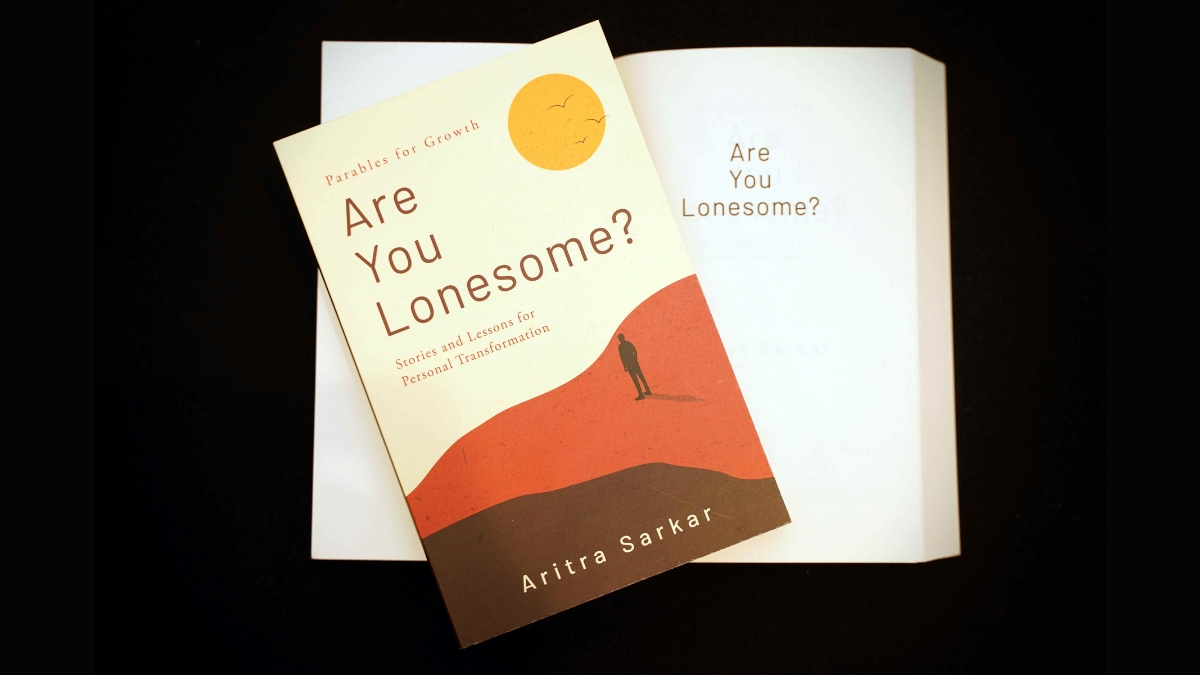
Kolkata (West Bengal) [India], July 16: Julie Banerjee Mehta is thrilled to find a storyteller of exceptional insights, relatability and unique compassion in her tete-a-tete with Aritra Sarkar on his riveting new book, Are You Lonesome?
It may remind you of the heart-wrenching Elvis Presley hit song, “Are You Lonesome Tonight?” Aritra Sarkar’s latest book, Are You Lonesome?, will most certainly strike a personal chord in you.
Or, it may make you think of The Beatles’ number, “Eleanor Rigby,” that goes:
“All the lonely people.
Where do they all come from?
All the lonely people
Where do they all belong?”
Sarkar’s book will make you journey inwards. Make you confront your experiences. And help you understand the most important person in your life – you. And you may already be humming the Elvis song that asks the same question. But does not give a solution.
After I read Sarkar’s book, Are You Lonesome?, I found he was, in the Jungian way, a total empath. Caring, analytical, and uniquely receptive. I slowly began to discover his deep-rooted compassion for human beings, which almost borders on the ability to understand a fallen angel, to understand what caused the fall.
This is an author and storyteller based in Kolkata. An alumnus of New York University, he spent several years working in the media industry before turning increasingly to literary and reflective writing.
His books include Goliath of Shenzhen (2016), an experimental dual-format novel told through prose and graphic narrative; Stress to Zest (Penguin Random House India, 2024), the first volume in his Parables for Growth series; Soulful Cal! (Wordphonics, 2025); and Are You Lonesome?, the second book in the same series.
His work brings together storytelling, psychological insight, and spiritual reflection, with a strong interest in emotional life, human connection, and personal transformation. Sarkar is also associated with the ABP Group’s educational initiative, Calcutta Media Institute, where he serves in an advisory role focused on nurturing the next generation of journalists. He continues to write across fiction and non-fiction, drawing on lived experience and acute social observation.
A book like Are You Lonesome? can only be written by a person with an exceptionally high emotional quotient, the Jungian empath, as I’ve stated above. Did this have something to do with Sarkar’s upbringing?
“I think my upbringing had a great deal to do with it. I grew up in a warm joint-family environment where life was deeply communitarian, and that gave me an early sense of emotional closeness and shared existence. But as I entered my teens, many of my aunts, uncles, and cousins moved out, and I began to experience loneliness for the first time. I was not naturally inclined to build friendships outside the home. There were few friends in my immediate vicinity. So, that inwardness deepened.”
“At the same time, my daily commute to school exposed me to the full spectrum of Kolkata’s social reality – from wealth to destitution – which quietly widened my emotional horizon. My schooling at St. Xavier’s, with its socially diverse student body, nurtured an egalitarian outlook, while the spiritual atmosphere of the Ramakrishna Mission also shaped my inner life. All these influences found their way, in different forms, into Are You Lonesome?”
Sarkar’s book has a large fan following across India, with readers identifying with his stories for one reason: the author is not preachy. He does not blame, he does not criticize. He reaches out as a friend.
His mathematical mind uses a multitude of genres, aphorisms, narratives, and conversational modes to draw the reader into the story of the six main characters in his six short stories, and unpack what it means to be lonesome.
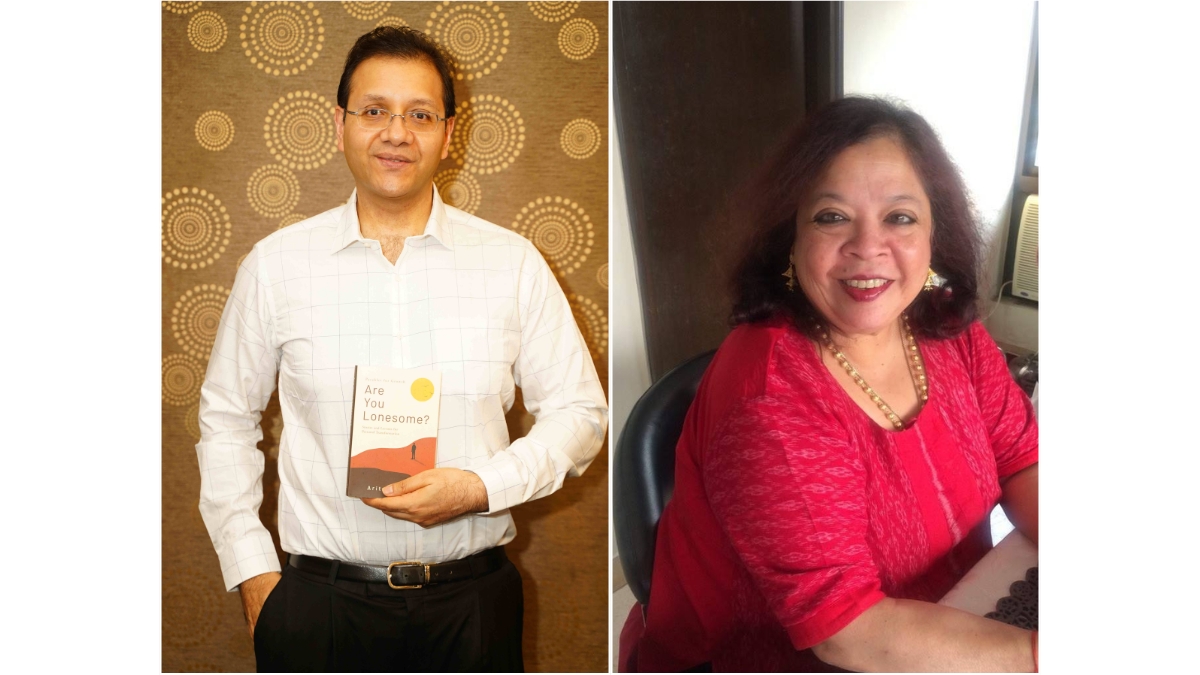
More than that, he never pontificates, never judges, nor does he ever criticize the central characters in each of his short stories. Rather, he always suggests we look inwards, to draw on our inner strengths to assess our state of lonesomeness – unable to connect to other human beings. What he does is show us, through gentle guidance, how to reconnect to other people if we have lost that connection.
This is not a self-help book.
“This book has been born out of a journey fourteen years ago. It did not come overnight. It started with chaotic events in my life. Those were triggers that allowed me as an author to move forward,” Sarkar remarks.
He found writing therapeutic, and the only way to get his emotions out on a smorgasbord.
“These ideas became experiences, experiences became stories. I went through hubris when I told myself I’ve made friends with myself but it turned out to be a mirage. After five years I saw these bunch of stories were segregating into different themes, following different emotions, different currents. It was a current trying to merge and I was travelling through different territories. The most powerful current within me was a deep sense of loneliness I was feeling.”
“When I came to the next phase, I felt that I should be giving readers a sense of direction related to these stories. The first thing most people face is a roadblock to even believe that there is a solution to their problems. That is what I was trying to give them.”
“That is where this format emerged, of blending fiction with non-fiction. Unlike what was available in the market – self-help books – which are didactic and preachy and formulaic. I thought if I could blend these stories with some insights, it would help readers to visualize themselves.”
One of the strongest solutions, Sarkar says, is:
“Love flows when you do.”
Most of us look for explanations “when love withers,” when we blame stress and emotional baggage.
“But when intimacy disappears, it is something more elusive. Most times it is that people have stopped expressing, not that they have stopped loving. What happens is that we wait for the other person to start the dialogue.”
He also reflects on the role of education in nurturing meaningful human connections.
“I think we must stop treating education as a hierarchy of command and begin treating it as a living exchange. To break that legacy, institutions must create environments where students are not simply recipients of information but participants. That also means rehumanising the teacher’s role – not as an unquestionable authority, but as a guide, listener and catalyst.”
Dr. Julie Banerjee Mehta has a PhD from the University of Toronto, where she taught World Literature. She is a columnist for The Telegraph (T2), Kolkata, and an author.